Years of Freedom
The Glass Bead GameYears of Freedom names the period following Joseph Knecht’s graduation from Waldzell, when formal schooling gives way to self-directed study. These years bring him unusual intellectual liberty and a rare interval of serenity, but they also follow the exhausting public role he had borne as Castalia’s advocate. His retreat from public attention and deepening absorption in the Glass Bead Game make freedom both an opening toward knowledge and a needed release from strain.
Beginning a New Period
At about twenty-four, Knecht completes his school years and enters a stage the narrative calls his years of free study. Apart from his uneventful boyhood at Eschholz, these are described as probably the most serene and happy years of his life. The account dwells on the particular promise of a young person newly released from schooling: the horizons of thought seem boundless, and neither the limits of intellectual dedication nor the dispersal of youthful illusions has yet become apparent.
That promise is especially suited to Knecht. His gifts do not drive him toward a single specialty; his temperament inclines instead toward integration, synthesis, and universality. The freedom to cross among disciplines therefore answers something central in his nature. Yet the narrative places this liberty within the educational formation that made it possible: discipline in the elite schools, meditation exercises, and the lenient supervision of the Board of Educators prepare students for self-direction. Without that prior structure, freedom could become a destructive scattering of talent, like the dilettantism attributed to gifted students in the pre-Castalian universities.
The Terms of Intellectual Freedom
After preparatory schooling, an elite student can choose fields of knowledge and research with considerable independence. Each semester requires a plan of study, but the authorities supervise its execution only mildly. Knecht and other students with varied interests may combine subjects, pursue several disciplines at once, narrow their studies early, or spend semesters using libraries and attending lectures without committing to a specialty. Their freedom is broad, though not without obligations: students report their lectures, reading, and research, and those enrolled in technical courses, seminars, Glass Bead Game courses, or the Conservatory of Music must complete the required examinations and work.
Exploration can delay admission to the Order, but the authorities tolerate and even encourage it. The annual composition of a “Life,” alongside good moral conduct, provides a recurring account of the student’s development. The arrangement gives Knecht room to range without making study wholly unstructured: self-determination operates inside a system that maintains records, sets certain requirements, and patiently allows students to find their direction.
Withdrawal After Public Responsibility
These years follow an unusually demanding stretch of Knecht’s youth. His education had involved not only strict schedules, scrutiny, and the rigor of elite schooling, but also the burden of responsibility arising from his relationship with Plinio Designori. As Castalia’s public advocate, he had taken on a task beyond what his age and strength could comfortably bear. He had brought it to a successful conclusion through exceptional will and talent, with the Music Master’s powerful assistance from afar; without that help, he would not have completed the assignment.
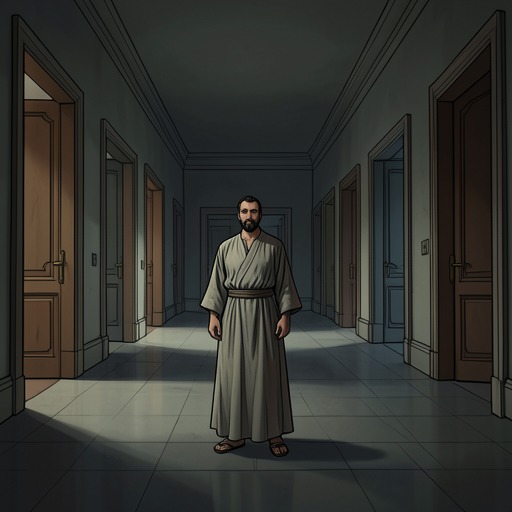
At the end of his Waldzell years, Knecht appears mature beyond his age and without visible signs of injury, yet the extent of the strain becomes clear in how he uses his new freedom. He immediately withdraws from the public eye and seems, in the narrative’s account, to seek a life as private as possible. The change is more than a shift of academic interests: after occupying a conspicuous position, he avoids the demands of visibility and society. The years of freedom thus begin as both release into study and retreat from a responsibility that had brought him close to exhaustion.
Study, Privacy, and the Glass Bead Game
Knecht’s freedom is not merely the absence of institutional demands. He uses it to pursue a broad range of interests, while a surviving notebook from the period records his developing thought about the meaning and theory of the Glass Bead Game. Its opening formulation treats physical and mental life as a dynamic whole and describes the Game as comprehending predominantly the aesthetic side of that whole, chiefly through images of rhythmic processes. The note gives a precise indication of the intellectual direction his private study takes: toward the Game’s capacity to represent relations and patterns, rather than toward a narrow specialty.
The Glass Bead Game increasingly enthralls him during this period. That growing attention accompanies his withdrawal from public advocacy: the energy once spent defending Castalia turns toward private inquiry into the Game itself. Years of Freedom therefore mark a change in the setting of Knecht’s intellectual life—from the visible demands of school and public responsibility to a quieter, self-chosen engagement with knowledge and its forms.